Born
in 1941 in Delhi Rameshwar Broota's interest in painting was evident at
a very early age. He did his graduation from Delhi College of Art in
1964. As
a young painter Broota's anguish at the suffering he saw all around him
and his anger at the greed and corruption in society was forcefully expressed
In his
early works which are a satirical and pungent comment on the social environment
of his times. In his Gorilla Series, that lasted for 10 years, from 1970
to
1979 Broota's
deep sensitivity to the crass materialism in society was reflected in the
Gorilla Man where he watched the world go by sometimes with revulsion;
Sometimes
with a sense of humor, and in this period Broota's creative genius gave
a new dimension to aesthetics in contemporary Indian Art.
Broota's
imagery then moved further, embracing the primitive Man that symbolized
the universal substance of the human being which did not belong to any
place or time. This Man, powerful, tragic and raw stood starkly, like a
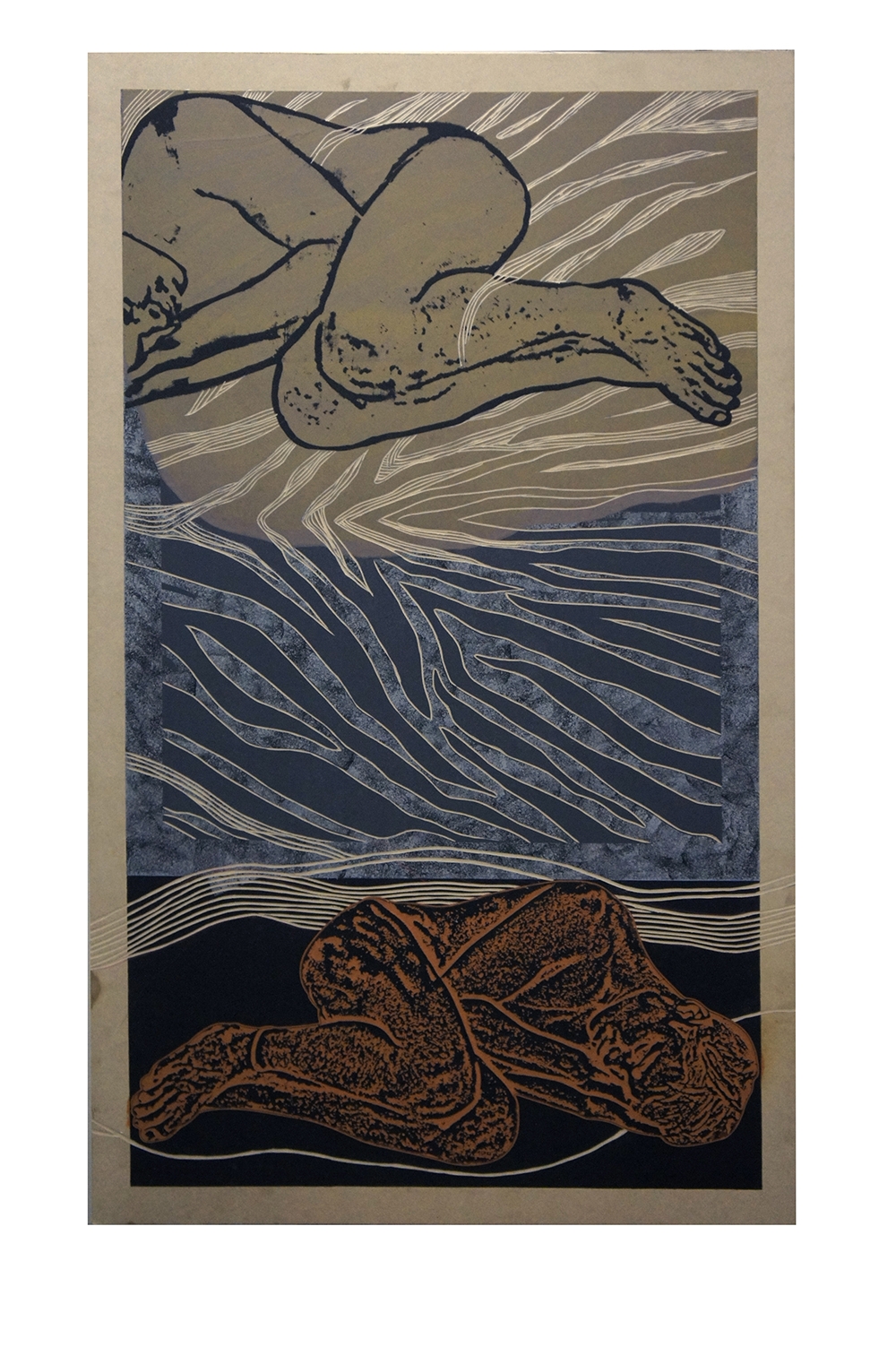
pillar. It was here in 1980, that he simultaneously found his new technique
of carving images by scraping out the layers of flat monochromatic paints
with the sharp edge of a broken blade. The discovery was important because
he carves out his images, going from one stage to the other without depending
on any kind of preparatory sketches on paper. On close examination, his
large canvases are infact, immensely intricate monumental drawings.
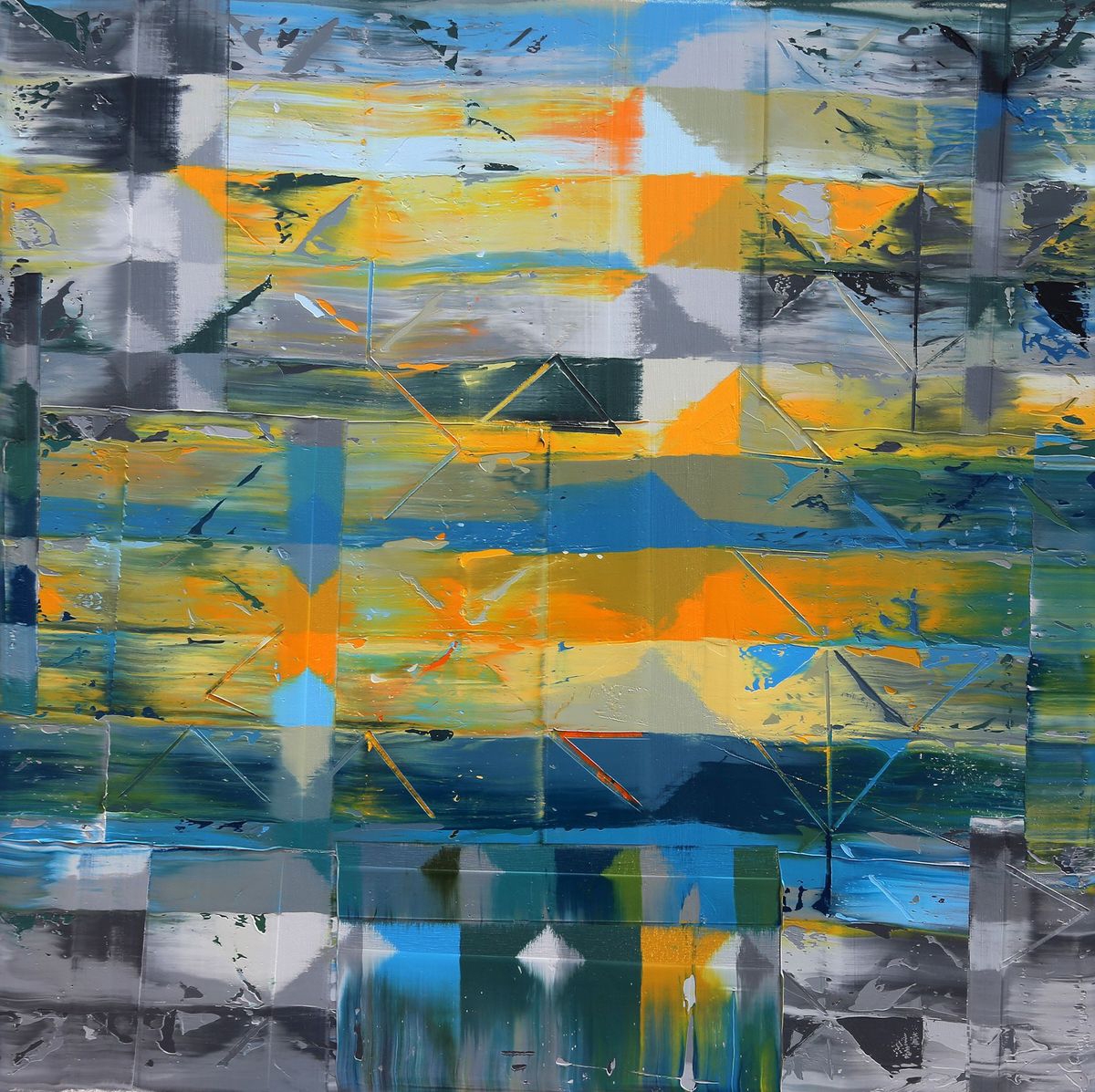
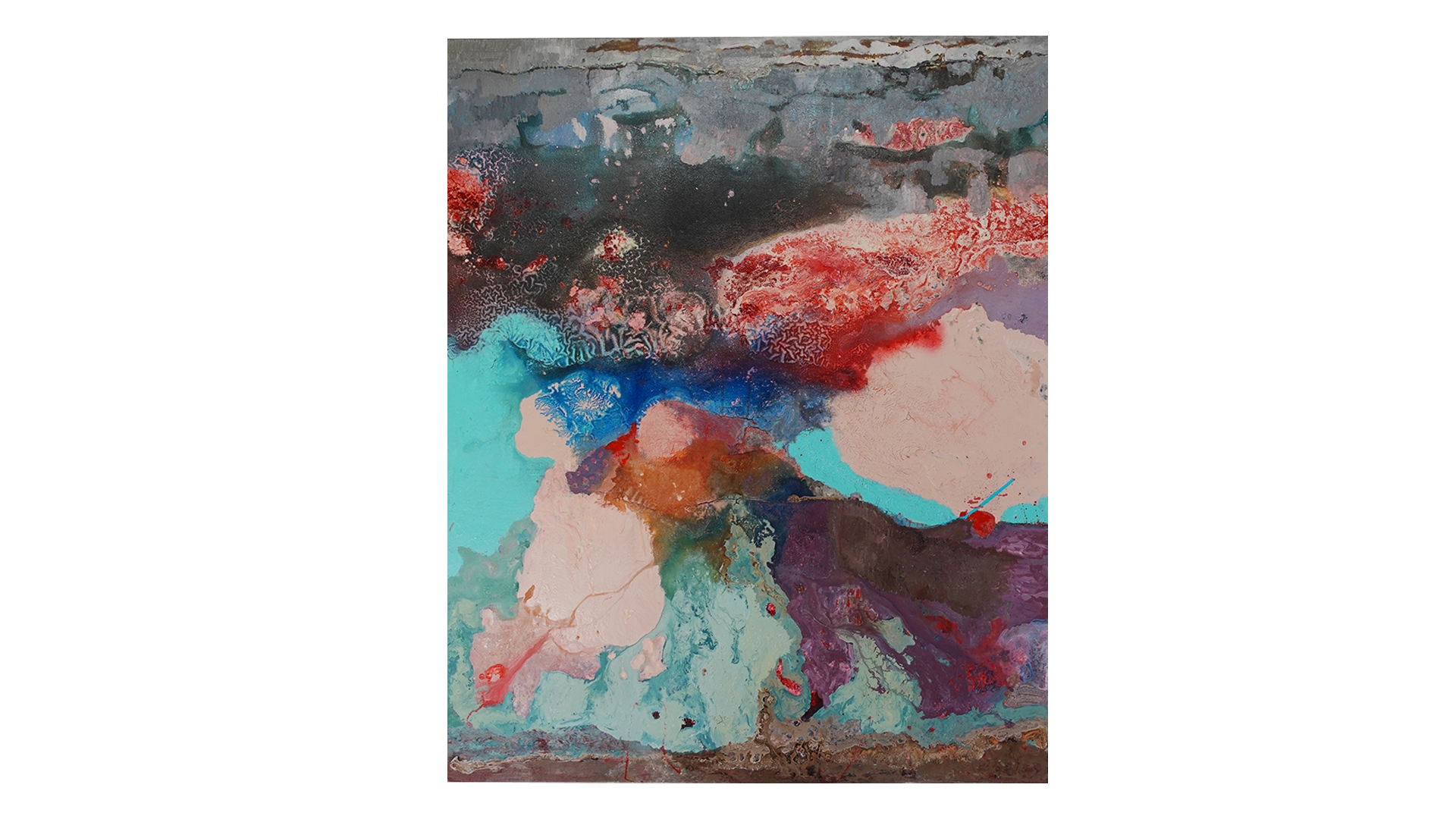
In his present
works, Broota has slowly moved into the realm of the timeless- the abstract-
where the presence of gross 'Man' has almost metamorphosed into the universal
substance, leaving behind and merging with the subtle and tactile surface.
In the meticulously but playfully scripted marks, dots and broken lines
the artist consciously rejects the limitations of readily readable and
recognizable forms and symbols and widens the scope of their meanings giving
his work a life of its own. The displacement of the body in its physical
strength and solid dimensions by marks indented on the surface of the earth
implies a kind of merging with the eternal; the focus in the recent canvases
therefore shifts from the time bound to the timeless. The marks, reminiscent
or archaeological findings, function as painterly symbols communicating
rhythms of time, of man, and of existence.
Broota never
had a solo showing of his paintings, by choice, in Delhi, though earlier
he had exhibited in Calcutta in 1984 and 1990 and in Mumbai at Gallery
7 in 1997.
The painter
has won three National Awards of the Lalit Kala Akademi during the years
1980, 1981 and 1984, the AIFACS Awards in 1973 and 1975 and the Hyderabad
Art Society Award for Graphics in 1976. He received the Senior Fellowship
of the Government of India for the years 1987 and 1988. He was
Conferred
the L. N. Gupta Memorial Award in 1988 and the Title Award 'Kala Vibhushan'
by AIFACS in 1997.
In 1985
he made some experimental Video art films which were shown at Shridharani
Gallery in 1987. In 1991 he made Shabash Bete on video with Vasundhara
Tewari in a workshop organised by Max Mueller Bhawan.
Before his
first major showing of his 'Gorilla Series' in 1971 in Delhi entitled 'Words
and Lines', he had already participated in number of group shows in Delhi
Silpi Chakra and elsewhere.
In 1973-74
his work was shown in a touring exhibition of Contemporary Indian Art in
Poland, Yugoslavia, Sweden, Bulgaria & Belgium. In 1972, he participated
in 'Graphics - Group 8' in Manchester. In 1976, he exhibited in the International
Art Fair Biennale-Cagnes-Sur-Mer-France. In 1980-81 and 1984, he participated
in the National Exhibitions of the Lalit Kala Akademi. In 1980 he participated
in the Exhibition of Contemporary Indian Art in Dubai. In 1982, he was
invited to participate in 'India Myth & Reality aspects of modern Indian
art' in the Museum of Modern Art, Oxford, England. His works were also
shown in 'Modern Indian Paintings' in Hirschon Museum and Sculpture Garden,
Washington D.C. and in 'Contemporary Indian Paintings' in Damstadt and
other cities in West Germany. In 1984, he exhibited his work in Gallery
7, Bombay; also in the Tokyo Biennale, Japan, and the Bangladesh Biennale.
In 1986, his works were exhibited in the Havana Biennale, Cuba, and the
Festival of Art- Biennale-Baghdad, Iraq. In 1987, his work was included
in the Festival of India, in Geneva and Switzerland and he participated
in 'Six Painters' Shridharani Gallery, Delhi. In 1988, his works were shown
in Taka Oka, Municipal Museum of Art and Meguro Museum of Art in Tokyo,
in the Festival of India, Japan. They were also shown at the Smith's of
Covent Garden, London, by Gallery 7. In 1989, he participated in-group
shows at the Display Gallery and the Shridharani Gallery, New Delhi, and
in the Timeless Art Exhibition and Auction by Sotheby's in Bombay. In 1990,
he exhibited with Gallery 7, Bombay. In 1995, he participated in the inaugural
exhibition 'River of Art', Art Today, New Delhi and Contemporary Indian
Paintings from the Chester & Davida Herwitz Collection, Part-I, at
Sotheby's Auction, New York. In the same year his works were part of Indian
Contemporary Paintings, Christie's Auction, London. In 1996, his works
were exhibited in 'Modern and Contemporary Indian Paintings, 100 years'
at Sotheby's Auction, London. In 1997, his works were part of Masanori
Fukuoka's Contemporary Indian Art collection exhibition organised by the
National Gallery of Morden Art Delhi, Bombay , Banglore Calcutta, also
in '50 Years of Indian Independence' - a group show organised by
Vadhera Art Gallery at the National gallery of Modern Art , New Delhi.
He also participated in 'Tryst with Destiny' organised by CIMA at Singapore
Art Museum in 1997 & Major trends in contemporary Indian art after
Independence, organised by the Lalit Kala Akademi. In 1998 , he participated
in a group show with Jogen Chowdhury , Manjit Bawa , & GievePatil at
Gallery Escape ,New Delhi.
Broota
's works are housed in leading collections in India abroad- The National
Gallery of Modern Art , the President's house , Lalit Kala Academi, in
Delhi, State Academies , a number educational & other institutions,
the Joseph Broz Tito Museum in Yugoslavia, the Kunst Museum in Dusseldorf,
&various private collection in India , U.S.A.,Germany, Switzerland,
U.K., France, Mexico & sweden.
Broota
has been the Head of the Art Department of Triveni Kala Sangam, New Delhi
since 1967.
(Back
to R.Broota's Home )
( Back
to Contemporary Art Home at IAC )