|
There are two tenets spelled
out by two of the world's most significant artists in contemporary art
which Manu Parekh recites like a mantra. They are as Joseph Beuys says,
"Show your wounds," and Anselm Kiefer's statement, "You cannot paint a
landscape after a tank has passed through it.
All his life Parekh has expressed
in his canvases the pain and anguish that he has encountered in the world
around him. Whether it is the Bhagalpur blindings or the Bhopal gas tragedy,
Parekh has sought to transmute his feelings about these shattering events
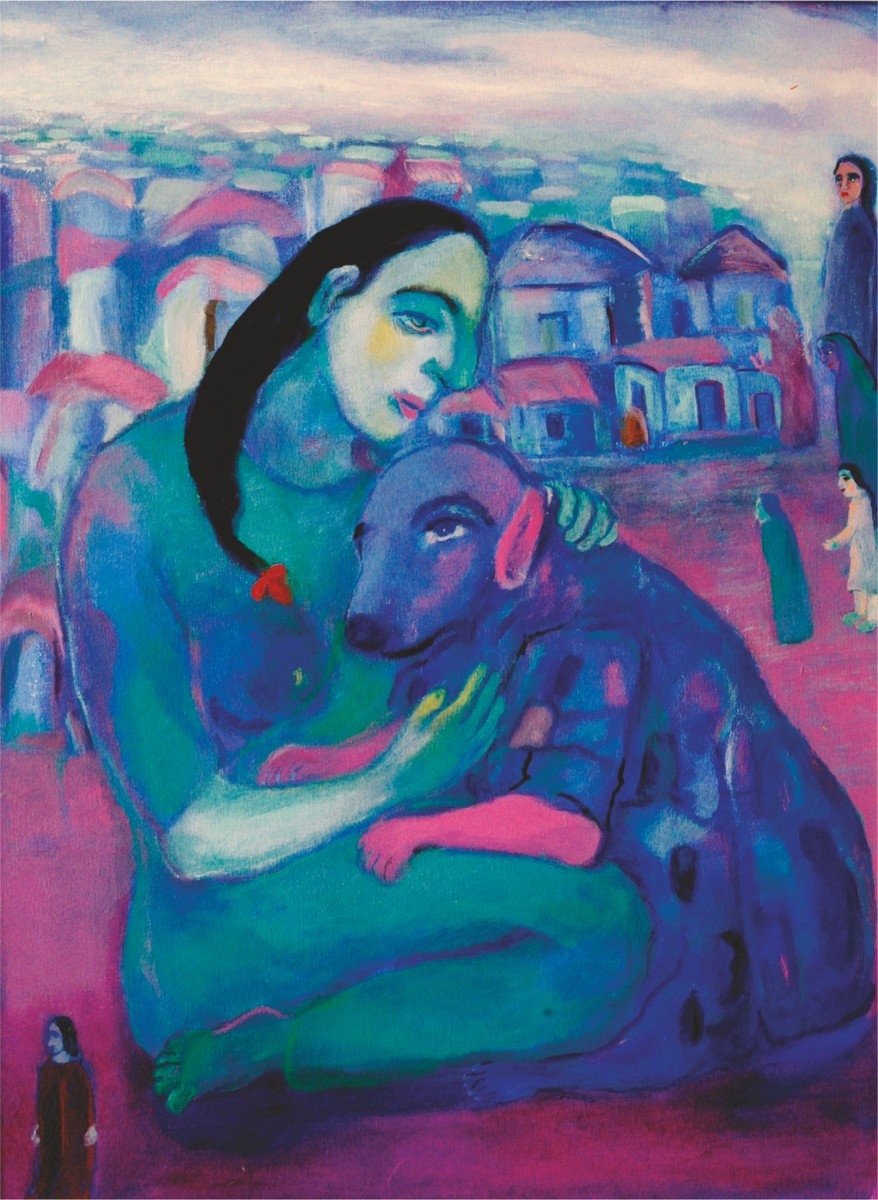
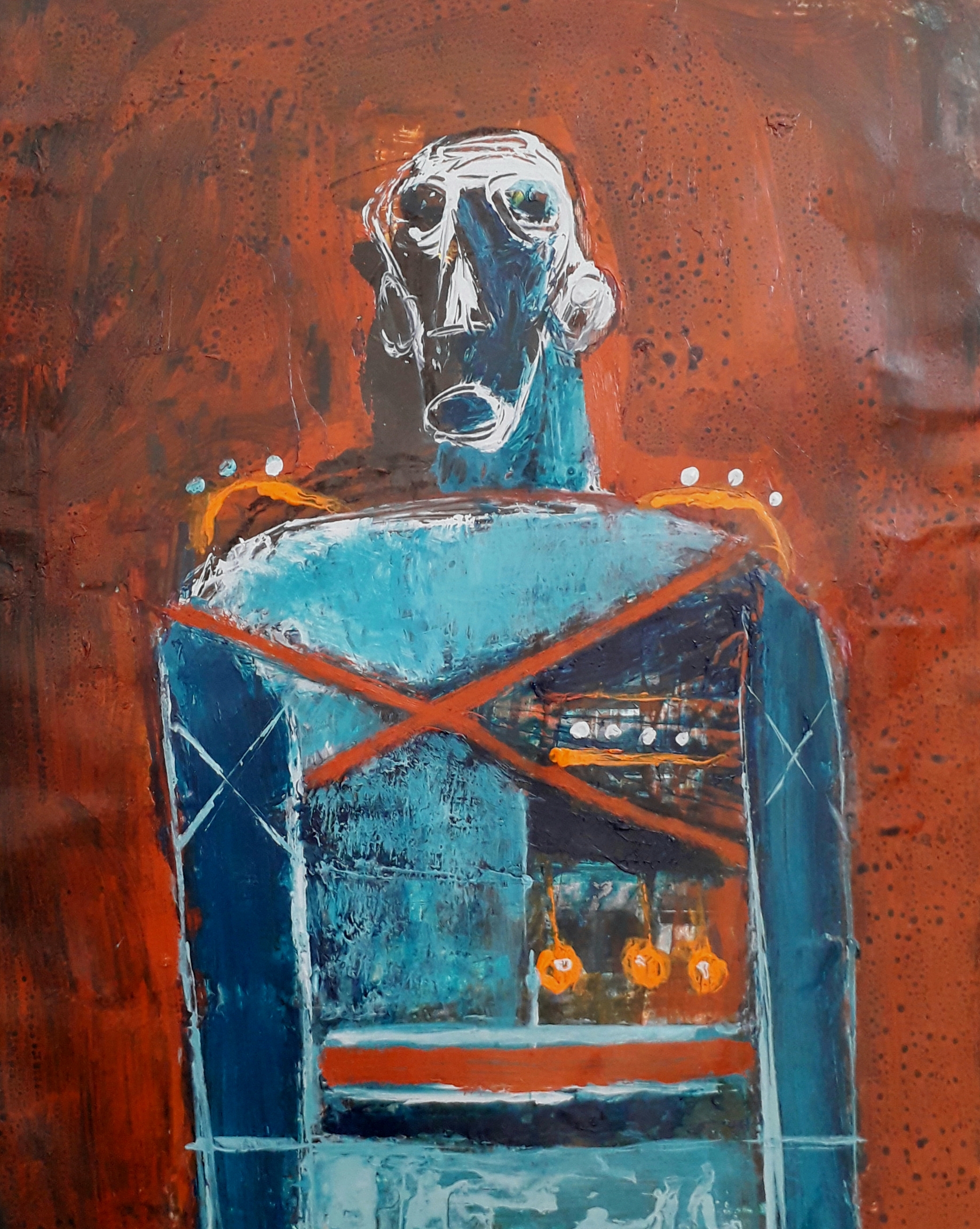
in a series of expressionistic images. Tormented faces and violently fractured,
distorted forms have been a familiar part of Parekh's visual language.
But Parekh is not always stuck in a groove. His latest series 'Homage'
- Recent Works by Manu Parekh bears ample testimony to that. Using the
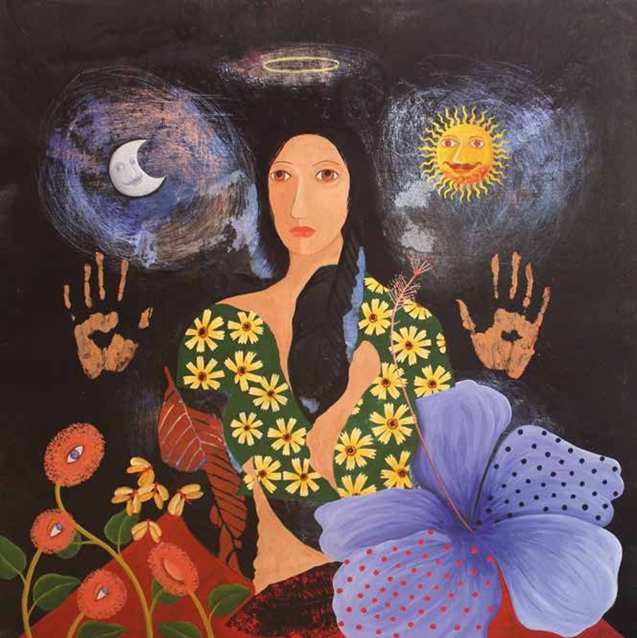
organic forms that have become an integral feature of his visual language,
Parekh has created unusual still life's using vases, flowers, leaves and
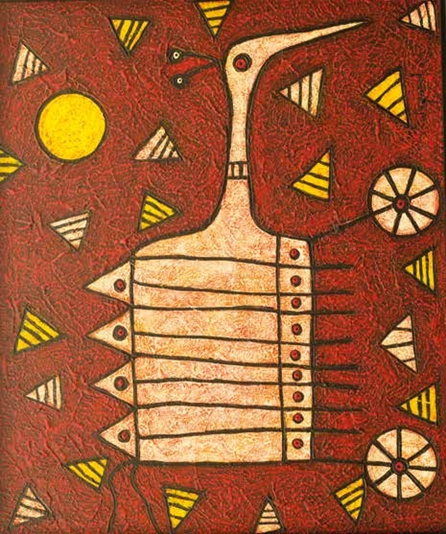
other vegetal forms, enhanced now and then with fantastic birds.
The new direction in his work
is a pointer to the ceaseless search that has guided Parekh's life. Born
in Ahmedabad in 1939, Parekh grew up in that picturesque city. He started
studying painting under Mukund Shroff at the age of 12. His other passion
as he grew up was Gujarati theatre. When he was old enough, he moved to
Mumbai to study art at Sir J. 3. School of Art. He received his diploma
in 1962 and supported himself by acting in Gujarati theatre. Parekh joined
the Weaver's Service Center in Mumbai in 1963. Two years later he moved
to Calcutta. From this time onwards his life took a new turn. Calcutta
and Santiniketan left their marks on him. The new series has a lot to do
with his exposure to the artists in this region.
ED:
What
made you decide on the present series which appears to me to be somewhat
different from your earlier works?
MP
: I have always gone back from time to time to elements from my own cultural
environment. Subconsciously, I have always felt that the western elements
never really became rooted in my visual language. Besides, I have always
felt drawn towards Calcutta and Santiniketan. My real moorings started
in Calcutta. I went to live there in 1965.
I was 27 at the time.
I had been feeling for sometime that the work that I was doing in Mumbai
was not really touching the core of my being. And then Calcutta with its
teeming population came as an eye-opener. I was vulnerable at that age.
ED:
Are the still lifes with flowers and vases a departure in your work, a
move away from the faces, the human. and animal forms and the architectural
elements?
MP :
Not really. True that I am doing a whole series of still lifes with flowers
and vases. But these have been appearing in my work since the Eighties.
It began with my first visit to Benares. I had gone to Benares in '79.
And I found flowers everywhere. They were a part of the ritual scene. I
had gone to Dasashwamedh Ghat and saw newly-married couples worshipping
Ganga with a profusion of flowers.
And then I went across to the
Manikarnika Ghat and saw the flowers on the dead bodies.
ED:
What
else inspired you to do the series?
MP
: Rabindranath influenced me deeply. There were three things in his work
which made an impression on me; faces, landscapes and still lifes. He was
so different in his approach to the landscapes and still lifes in the European
tradition.
In landscapes done by European
artists, the sky forms the background, the water is the foreground and
the middle ground is occupied by trees and other vegetation. Rabindranath,
on the other hand, gives equal importance to the treatment of the sky.
It is the middle that is in shadows in his paintings.
Similarly, in European still
lifes, the compositions of fruits and flowers reflect an opulence. The
vases in them have a minor role of being a prop. But in Rabindranath Tagore'
5 still lifes, the vase is not secondary. It also becomes a character.
There is a more organic quality about the forms. The pots holding flowers
become like human figures. These are elements which excite me and I want
to incorporate them in my work. All these influences worked on me subconsciously
all through my stay in Calcutta. Besides Rabindranath, the Santiniketan
artists affected me a great deal, especially, Rarnkinkar.
ED:
You have used a lot of bird forms in this series. How do you relate
them to your preoccupation with Still life?
MP
: I have used the birds to bring the pictorial space to life. Birds are
a symbol of life, of movement.
ED
: You have a predilection for organic forms in your paintings. There
is also an overt expression of sexuality' in your imagery? The depictions
of nature by the Santiniketan artists were not quite in the same.
MP
: The erotic area in human existence is important to me. I am always involved
with growth, fertility, burgeoning life in my paintings. So how best to
show it? The rhythms of life, I feel, can be best-expressed in the rhythms
of the coupling of two beings. I think it is the best replication of nature's
rhythms which I want to capture in my work.
ED
: And what about violence?
MP
:There are two poles for me. One is the area of organic growth and the
other is violence. I want to capture the here-and-now reality in my work.
And violence is very much a part of that reality.
ED:
And Where does Cakutta fit into the scheme of things?
MP
: Before I went to Calcutta in the mid-'60s, I was living and working in
Mumbai. The two painters who had some influence on me were Souza and Jeram
Patel. At the time, I was painting some imaginary landscape within me.
But Calcutta swept me off my feet.
tremendous human tenacity. I
was fascinated by the human potential in the city. The struggle for survival
was such a powerful instinct there.
Besides, the city was warm and
friendly. I have always enjoyed the collective life, always enjoyed group
activity. Sharing is important to me.
It was easy for me to make friends
with the Calcutta artists. The Society of Contemporary Artists invited
me to join them. It was with some Society members like Shyamal Dutta Ray
and others that I first went to Santiniketan. It was a mind-blowing trip.
The impact of Calcutta changed
my painting style. I began to paint on dark backgrounds of browns and blacks
with white strokes. I also started making paper collages with toni-up drawing
paper. These collages had elements of accident and geometry.
ED:
The
sense of place or genius loci, as they say, is very much there in your
paintings. Tell us about the other city which has played a very big
part in your paintings Benares.
MP :
From Calcutta, I shifted to Delhi in 1974. I was a design consultant to
the Handicraft and Handloom Corporation of India. I became immersed in
my design work and travelled extensively in the villages. Delhi as a city
did not inspire me. It hardly left any mark on my visual language.
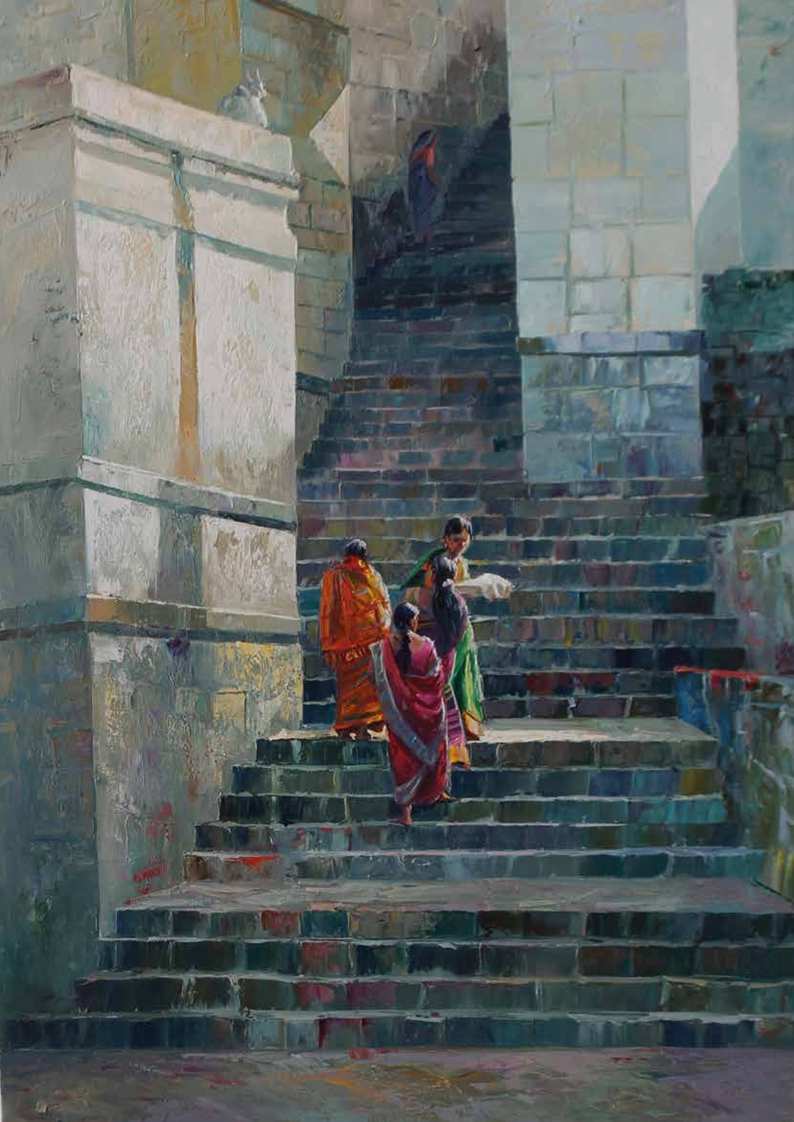
In 1979, I went for the first
time to visit Benares and my spirits lifted. Benares, like Calcutta was
full of contrasts and contradictions. I was excited by the signs of organic
life and human presence.
Rabindranath Tagore came to
my mind in Benares. I looked at the sky and realised that the Indian sky
is different. I decided that I would use the various elements that I encountered
but I would bring in contemporaneity.
I discovered another dimension
to the city - its spirituality. Husain and Ram Kumar had both painted
Benares. I wanted to paint it
differently and it became a pivotal city in my paintings. Sometimes I created
Benares as an imaginary landscape
which reflected the moods of other real life experiences.
ED
: How much has your experience in theatre shaped your visual languages?
MP
: Well, theatre helped me to create a locale, a landscape. Besides, lighting
fascinates me. These elements surfaced in my Benares paintings.
ED:
Would
you like to talk about the faces that form a significant part of your ceuvre?
MP :
Yes, faces excite me. My stay in Calcutta and Benares and my travel through
Indian villages have given me a portfolio of different human faces. There
are elements of theatrical language when I do a face against a dark background.
When I do a face it is also a landscape and when I do a landscape, I am
painting a situation which has many realities.
I also feel that the Indian
face is poised between faith and fear. These are two important dynamics
shaping the life of the collective. The common man whose face appears in
my works is the biggest component of a collective. For me, it offers tremendous
human
material, big possibility.
ED:
How has your work as a designer influenced you?
MP
: As a designer, I was not engrossed with the craftsmanship, per se. What
absorbed me was the situation that produced the craft. But I learnt in
a big way from the respect for craftsmanship, its sustaining power, and
the dynamics of repetition.
ED:
You
have used a lot of different material and mediums. Would you like to talk
about it a bit?
MP:
Material and mediums are very important to me and any change gives me a
kick. I discovered rice paper on which I am doing my recent series of paintings,
in the early '90s. I find the possibilities of texture and the interaction
with paint extremely exciting. Here again the work of the Santiniketan
stalwarts fliscinated me.
Similarly, when I did the series
on violence in 1996, I used board and cement to achieve texturisations
that would create the sense of wall graffiti. But then again, I go back
to my interest in pure oil and canvas.
ED:
What
has painting meant for you?
MP:
There is a concept in Bhaktimarg of Chitraseva. I look upon my painting
as a similar commitment. I want to be totally involved. All my life, I
have struggled to capture the real Indian figure, still life or landscape.
I wanted to create a particular identity suited to my reality. At the same
time, I want to remain spontaneous. The subconscious, I feel, has a role
to play.
Interview conducted by Ela Datta
author, critic and journalist May, 1998
|