
Mighty Pens
 
Watched as he works like a child,
His grey beared incites the wind,
His eyes look up, more then mild,
As though they haden't created anything.
But the flowing bodies grow under his hand
And faces take shape, &a world his own,
As though he was God, & no people 
Existed before his were born.
 
When his hand freezes imprecise images & inks into form,
His world turns slowly to ice melting in each direction
Towards a truth few can face,
The horror & happiness of creation.

Dom Moraes
(December 1987)

 I have to state, at the start of this small note on a friend, that I know little about painting. However,
I think I owe a bit about the world from which"painting" comes and in which it lives:
 I.e., the world of huge, desperate politicians, their wars, children walking a line to massacre, or to school, the sinuous movement of wind on the river, many countries, the grunting heave of sea, the astonished bark of dogs frightened at night, as the gunfire comes closer, the anger of parents, the sudden sadness of wives, and, as life continues, an awareness of incompleteness within oneself.
Therefore, knowing at least these things', I am capable of writing this note about a friend and his painting, rather than about the paintings of a friend or the paintings of anyone in particular. Jatin Das is a bearded and wiry man who, when I meet him, always seems in a state of excitement over trivial as well as what art critics call "intense" perceptions of the world we both breathe, the world in which his arm whirls, not hurling but placing colours on the canvas before him. As the endless inches of paper which the writer, a snail, crawls across, are the compass of the writer S life, so the endless yards of canvas at which the painter brandishes his brush are the compass of the painter 5 life. Jatin Das is clearly determined not to allow an inch of his life or his perceptions during it to escape the delicate turn of his brush.

I once came to his small house in New Delhi in the midst of an imperative sunset. Admitted to the cool room in which he paints, I sat amidst colours and precisions of line, and listened to the high cries of children outside: little birds of the world whom he, hawk like for the moment, attacked on canvas with his brush. His heard, Aztec, tilted upward, and he appeared to listen, for a moment, to a colour, before he attacked the canvas once more. In him I saw the few good painters I have known, Francis Bacon, Larry Rivers, Lucien Freud, Hussain, Souza, not because of any similarity in personality or style, but because all were the watchful ones, the listeners with their eyes, those beyond attachment, when at work, too much beyond the sealing of vision into paint with the help of distillations of vegetables, animal substances, chemicals, and other such appurtenances of medieval necromancers. Writers, each with his headful of visions, his typewriter, and his foolscap, and neater, more explicit, more knowledgeable, have always been in advance of painters, I feel; though perhaps I shouldn't say so here. But in that flary, smeary sunset, I saw Jatin Das as part of his tradition, not simply of Indian painters but of what is called painting

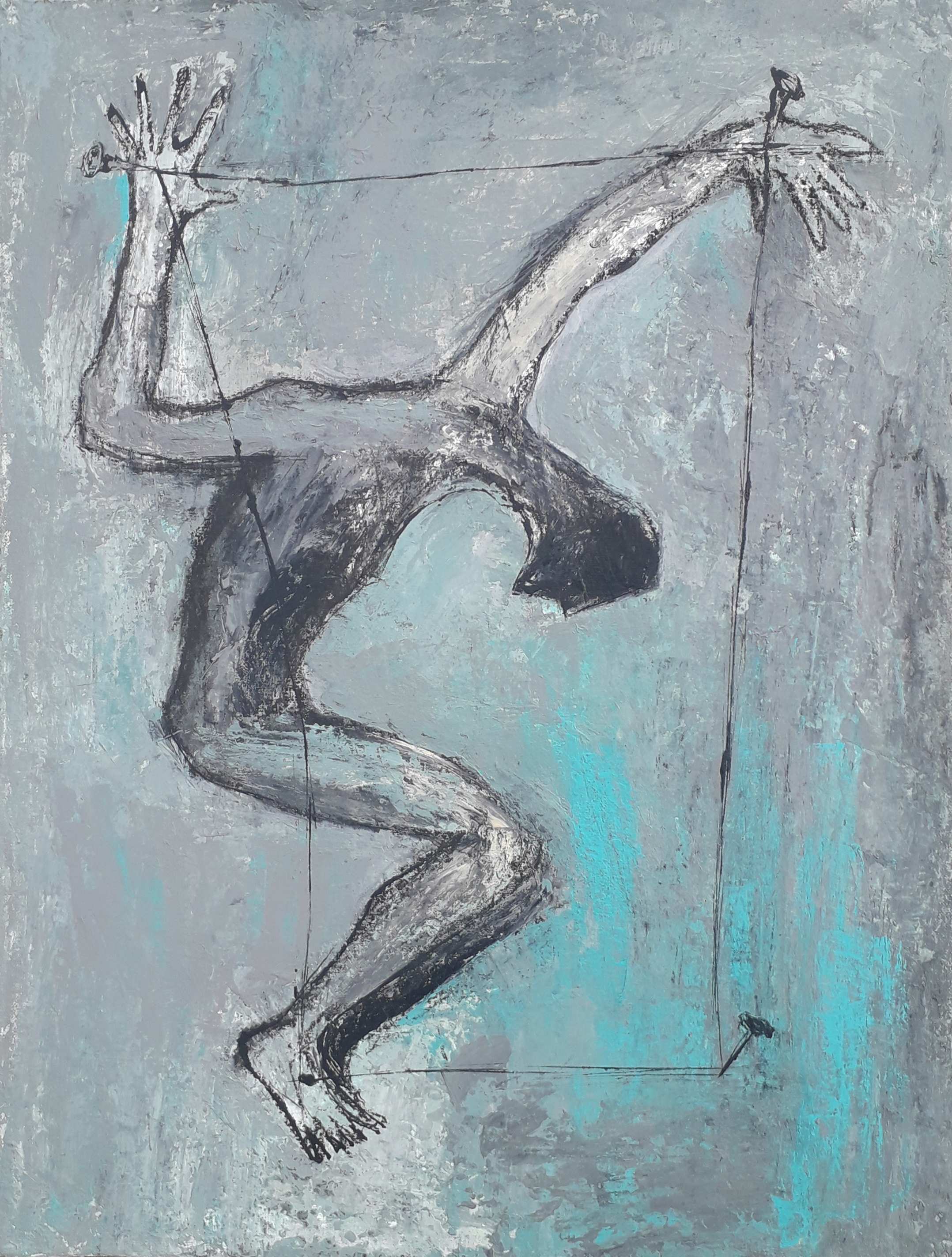
The action of his paintings (and I speak once more not as an expert but as a person accustomed to lo9k at the world and everything that inhabits it) seems to take place outside the canvas. It is as though the figures were poised on parachutes, about to descend - or, if it were possible, ascend - and leave the rest of the canvas to its 6wn significance. This would be as though all of us (as all of us will one day) lifted off on our individual parachutes and left our various spatial areas on the earth unoccupied. For the areas of each of Jatin Das's canvases, even beyond the figures, have in there colours their own weight, substance, and significance, as the earth, when emptied of the few cubic feet occupied by each human body, would continue to have.

The figures in the paintings might. well afford to leave their hands behind in the absence they create, as ghosts are rumored to do in West Africa, for the figures made by Das, weightless in the frame, convey much of the tension, the hurt, and the energy of the world in which they once moved or perhaps will move some day.

Because all this is a little relevant t9 the friend I know and his spoken ideas of how the world and his work function together, I respect what he does. I have many friends and acquaintances, some of whom work in unfamiliar media like paint, stone, wood, textures my fingers and eyes like but which I do not understand, some of which work in my known medium, words or film. The bulk of these people I do not respect workwise, for what they say does not correspond to what they do. Nobody's statements can correspond exactly, after all, to what he does. But with Jatin Das4 I am certain that his hand and mind respond beautifully and immediately to the voices of children he hears as the colour in his Delhi studio, to the wails of the hawks as circle lower for their prey to the trains and buses and above all to the bodies of people, people on parachutes as they always are, who will loose themselves of his light tunic of paint and leap beyond his canvas and become.

Therefore what he says with his painting arm is valid, and while he remains the talkative, nervous bearded chronicler of his own visions, I do not think what he says will ever cease to be valid.

DOM MORAES


[ Next ]
[ Back to Jatin Das's Home ] [ Back to Contemporary Art Home at IAC ]