A Tireless Mission

by Roobina Karode
 

       Anupam Sud's art consolidates her humanistic leanings over her feminist ones, reflecting upon the nature of humanity in all it's forms. She works, one might say, with a social and political consciousness that may not be radical, but effects a subtle intervention by speculation rather than statement. Her deep knowledge of past artistic traditions, of the cultural dynamics that prevail in the Indian context and topical events is the trigger that ignites her imagination.The sweet bitter taste of life that occurs in the wider world of everyday experience engages this artist.The themes of manipulation, the relationship of power to predicament, of powerlessness and temptation, human fallibility and trappings, the masked existence of urban people, the inertia of government structures, are some of the recurrent themes that engage Anupam's thought process.


             When encountering Anupam's work, what strikes one immediately is her 'sensuality of seeing'. Whether humans or objects, they are represented in their full-bodied corporeality- their skin and flesh, texture and volume captured most effectively by well-delineated contours and in the black and white (light and dark) ambiance of etching. It is her eye, and an acute sense of the 'optic' that guides her hand in shaping the physical reality of things. Anupam remains a committed realist, even to the extent of sometimes being photographic.This sense of realism though is not reduced to a sterile function of flawless copying, but refined by an intuitive vision of the perceived object in the pictorial construction.The narrative itself is packed with telling details which provide important clues to the social satire, the wit and the clever ridicule infused in the infinite oddities of human situations. Anupam, I think intentionally confounds both the subjective and objective worlds, where the obscure is sighted, the uncanny revealed and the incomprehensible called to account.


             Art for Anupam is not an instrument of reform. Though not made defiantly or in conscious conflict, it is far from being benign as a mere pleasurable sight to entice and relax the viewer. She operates outside the narrow boundaries of 'art for art's sake'. The dual nature of reality fascinates her and is seen in her interest in polarized situations. Disqualifying traditional iconography as unsuitable to her expressive goals, she frequently attempts to divest the human form of all cultural markers -caste, creed, clothing and nationality, to represent a universal symbol. Reflecting her own personal nature, her figures dismiss confrontation and direct retaliation. In self-absorption, they are 'set apart' from the familiar daily environment to fully allow the effects of emotional and aesthetic experience. Anupam's portrayal of the world at large is far from utopian, or one that halts the world at some ideal state of resolve- instead, life to her is always caught at the edge of vulnerability, nurturing her eternal quest for meaning.


              The pictorial world of Anupam is predominantly anthropocentric. Her interest in humanity is undeniable. There is a strong urge to examine 'prescribed' human attitudes, complemented by her rather indirect style which is suggestive and cool- yet hard hitting and disturbing, when it lingers with a pregnant silence and existential angst. Without emotional outburst or the manner of expressionistic fury, and continuing in the figurative tradition, she creates and concerts her imagery in a carefully articulated space, unfolding the drama with an ambivalent complexity of life experiences. In emphasising visual appeal, 'form-experience' seems crucial to Anupam as a visual artist. For her, everything that is thematically relevant and artistically valid must translate into a visual language. Drawing is the backbone of her work that structures, measures and alters the space-form relationship. Her lines bear the mark of being effortlessly drawn (on a zinc plate with a pointed tool) delineating her characters with an amazing tautness. Upon that, the magic of chiaroscuro, the flawless gradations of tones project the nude forms, almost sculptural, closer for the viewer's scrutiny. There is a serious engagement with the surface treatment, enriching its sensuality with a variety of textures, the secrets of which are revealed only over long years of working. The cracks, blisters, wounds, relief, blurring and smoothness of the surface are manipulated for the characterisation of the form. Many of her recent works are multi-media prints where she has visualised the final image, combining the etched image with lithographic or silk-screened images.


              To elaborate on the content of her work, Anupam mingles historic, religious and mythical references with her current concerns and realisations. For instance, the Christian theme of' original sin' that confirms human fallibility, or woman as temptress have been chosen by Anupam for connotative alteration -but is it about a human propensity to chase the forbidden or about association of evil with pleasure ? One could recount Anupam's views on the man-woman relationship which to her oscillates between mutual exploitation and tender coexistence. The 'Game Series' provides alternating views of exploitative situations, where the man and the woman, both in different contexts, are shown in manipulative moods. The work is bordered with hunting scenes drawn from books on history and mythology, emphasizing the eternal continuity of the theme, only that the players have changed. The meaning condensed in the signs refers to a savage human instinct -that conquers, kills, attacks, subjugates and rules. The man playing the queen in a chess game, or the nude woman audaciously plonked on a couch with a snake (inseparable from her since the original sin), and the vertical grid metaphorically used as a ladder with framed portraits (of lovers?) in 'Snakes and Ladders',comment on the endless game of life. The victim is invariably the weaker one- man or woman, with gender not being the issue here.


                Anupam uses humourous ways of representing otherwise serious concerns. For instance, the spoof on the story of the princess and the frog, where the fairy tale is parodied into one with a prince and frog. Perhaps in view of the disharmony of gender relations, Anupam juxtaposes the fragmented images of female foeticide and highlights an alternate biological choice with erotic forms and men applying lipstick, suggestive of a possible future homosexual world. In 'Dialogue', one version has two men in communion, characterised more by their gentle touching than speech. While the men are located in an open, public space, the dialogue between two women in another version takes place in a dark, domestic and private space. As it happens in life all the time, there is suspicion also when persons of the same sex become companions. Anupam expects the viewer to read or misread the relationships in multiple ways, validating their power to make meanings.


               One notices that Anupam rather consistently uses the strategy of literal substantiality in her work where objects with popular associations help familiarise the content. The chair, the ladder; the halo and the dice are symbolic references to power, ambition and manipulation that Anupam frequently deals with in her work. 'The Red Chair' (literal ly) and 'Succession 'are infused with socio-political meanings.The underlying issue perhaps is: have power positions been reduced to the game of musical chairs, where succession rests on chance rather than merit? 'Don't Touch My Halo' has the overwhelming centrality of a heroic male figure in a rigid statuesque pose, holding the fruits of his success, and the dancing apsaras with their sensual body rhythms, as glories of his life. In contrast to the powerful handsome exterior (his temporary facade), the skull under the seat is a metaphor for his hidden inner self and hollow structure. The man's only preoccupation is to protect the crowning nimbus and cling tightly to his chair. 'The Shifting Halo' is antithetical to this, where with the abrupt collapse of power the halo has already shifted from the dead man towards the virility and power of youth. The cold, ice-slab architectural space, the hard rendering of the face, the cropped body and the exact nature of its placement, the strong sense of shadows and silence make for a harsh visual isation of the theme. There are other works dosed with concerns for pollution, hazards of industrialisation, barrack-like structures, erratic electricity nuisance- all familiar stories, but invested with personal and collective meaning.


             'Dining with the Ego' holds mystery inspite of a material sumptuousness. A sharp contrast in image is visible, with the man hogging merrily and the woman with an empty plate. The irreconciled situation creates a kind of visual discomfort inspite of the table with its luring spread. Similarly, some of the other works represent a feminine concern, where an empathy and a pained compassion pervade the imagery. Women seem to be framed, however obliquely, in a man-centred world of marriage, physical violation and invasive medical techniques. In 'Between Vows and Words' the holy matrimonial vows are suspended in doubt. Anupam plays with the discord, effectively created between the uttered words and action, the text and the image. 'The Ceremony of Unmasking' is a triptych with a muscular masked man, a dog as metaphor for the libido or the beast who sniffs flesh, and two masked men in the ritual of removing the woman's mask. The conflict between the self and the other is manifested in shades of grey, as the woman is in the act of being bared, both in mind and body while the men continue to mask their feelings and true identity. 'Wee Hour' shows a woman in a crouched position, shaped almost into a shell form that symbolises protection, yet she is vulnerable, not guarded from her dreams and latent desires. The incompatibility of the mind and the body is sensitively etched out in many of Anupam's works. Her recent prints quite regularly feature the intentional visual demarcation of mental and material reality; the body and the accessories are separately juxtaposed with meanings implicit in circumstantial relationships.


              Focused on the world of irresolution - dichotomous situations, moments of unrest and disquiet, and the air of uncertainty - there is no obvious or even apparent autobiographical content in the works of Anupam Sud, though it professes a personal viewpoint that makes an unconditional assertion. The human figure, the primary means for exteriorizing expression, is positioned amidst a deliberately fostered ambiguity. Often the characters are haunted by a feeling like 'we had the experience but missed the meaning.' Communication, I suppose, can never be totally unproblematic. Life manifests itself as an anecdotal record of such innumerable instances. In Anupam, the analogy and experience can extend to art as well. As an artist and as a person, Anupam is critically discerning, with a self-analytic ego secure in its self doubt. She is a thinking artist who never works with a set pattern but invites fresh challenges and seeks new discoveries with each work. Her print collages, for instance, are abstracted bits from several of her prints that make up a pictorial psuedo script. She enjoys the variety of blacks that emerge as a result of different papers used in her prints. One observes that in a rigorous medium like etching, Anupam has shown courageous preference for large formats. In fact, her zinc plates are getting larger and larger. She explains, "With drawing, the journey of the mind begins and webs stories around the theme that demand space to accommodate the monumental scale of the characters." Overcoming all repressive barriers, she comfortably etches the male and female body in its stark nakedness -minus all gloss. To , technically, her attraction for the unbroken line and contour heavily compounds with her perceived human form. While shaping her narratives on the zinc plate, she indulges spiritedly in the aquatint process, often darkening the entire field and then reclaiming the whites in a most painstaking (and challenging) way. Anupam's final print makes a 'gradual emergence' after a sequence of improvisations and remedial measures perceived by the artist while pausing amidst the spaced acts of executing prints. Working with the reverse image and visualising its 'positive' side requires special insight. Also, drawing and scraping need the plate to be positioned flat on the table but at intervals the plate needs to be placed on the board to register distortions and incongruous working. Her hand, that transfers human touch and energy, varying in pressure, force and feeling, remains undoubtedly her most important tool of working, fine tuned with her entire being.


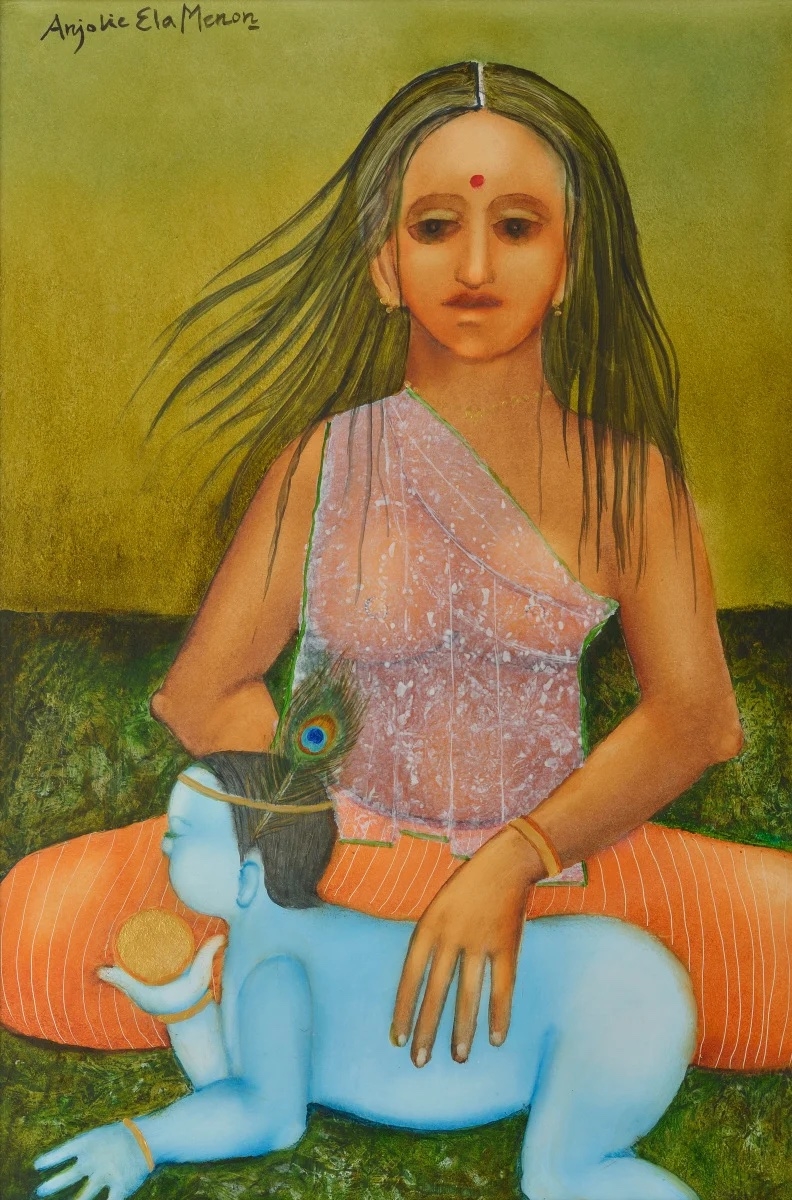
               When placed in comparison to some of her female contemporaries, her style of representation seems uniquely prosaic, even masculine, against the soft delicate style of Nilima Sheikh, Anjali Ela Menon, Gogi Saroj Pal, where an overt feminine sensibility and the romanticisation of the content are visible. Anupam attempts at greater detachment and perhaps more cynical insights in her work. 1997 was a crucial year in Anupam's life. On the one hand, her return to the Slade School of Art in London (where she spent her formative years, studying printmaking in the 70s), resurrecting her links with the place that helped shape her artistic talent, and on the other hand the deep personal loss of her father as he succumbed to his last illness. The duality of life surfaced again. Moments of vulnerability were overcome with self-induced strength. Though she could not do much work then, a sharp mind stored and framed memories of loss, mortality, death, absence and transcience, much of which has re-appeared in her recent work. 'All Paths Lead to Me' was done before the passing of her father, as if etching a premonition. There are men standing visibly in memorial stones with the mythological reference to words of Lord Krishna inscribed on the stones. The lower area, a separate plate, depicts a man in (eternal) repose on the wooden cot that carries him on his final journey. Again the contradiction in Anupam, wherein the man in the centre above, though captured in a posture of certainty, expresses uncertainty - not knowing where to go (or perhaps where any of us will go).


             'Of Walls' an earlier work is based on recollections of childhood memories - the walls of the ancestral 'kothi', covered with graffiti, that were so difficult to jump over in childhood and now seem to have shrunk. The faceless presence of time is personified in the woman's image while the recumbent male figure, legs folded on one another, is reminiscent of the very familiar sight of her grandfather resting. More than anything, it is the mystery of time, its being there and yet not there, that engages Anupam on her journey down memory lane.


              When at the Slade recently, she found that etching had been all but abandoned in favour of the new electronic devices that ease the processes of printmaking. Anupam there rejuvenated her skills in silk screen method and in lithography. 'In Search of Two Years from the Past through First and Second Class Mail' is a break from Anupam's easily recogn isable works.These are large colourful silkscreens in the magnified format of a posted envelope while at the Slade. They carry the spontaneous handwritten imprint of names and addresses by many of her teachers and colleagues. The monochrome human images are symbolic of people walking through time, in some subtle way their anatomies distinguish them from one another. Printing the stamp was accomplished after a back-breaking exercise, taken up as a challenge. To her credit, without adequate infrastructure and an advanced equipped environment for printmaking, an artist like Anupam Sud with the superior quality of her prints has made a mark both nationally and internationally. She proudly believes this to be a unique Indian trait - "...to be able to strive so hard with so little in hand."


            From the late sixties, Anupam had made the choice of a medium that could assert a democratic conception of art. Printmaking as intended for reproduction was her preferred medium, to remove art from its high class preserve and make it available and accessible to responsive viewers and art lovers. As one of the founder members of GROUP 8 (1968), Anupam with her printmaker colleagues worked through the association to promote and sustain printmaking as an individual, expressive art form that is naturally prone to collaboration. It may be argued that the medium often decides the subject of representation. Just as there are certain themes that are more apt for painting than sculpting, Anupam, who paints as well, corroborates: "My print images can never convert into painterly images for the canvas, as the working body itself rebels. When images enter my mind, I see textures that belong either to etching or to painting. Speaking for myself, I see no easy conversions as the basic temperament of each process varies and so do ways of arriving at the end result It."


             As printmakers update and go all electronic, Anupam in many ways is an old-fashioned, slow but steady mover who after thirty years continues to passionately refine her skills at etching, inspite of having attained high levels of technical brilliance. The long tedious hours of physical labour, studio confinement amidst chemicals, machine presses, heavy rollers, metal plates, burners and innumerable tools have become a way of life for her - with no substitute. She believes nothing worthy can emerge in the absence of perseverance. She is firm on her lifetime commitment to printmaking, especially etching, that is second nature to her by now. For Anupam, no fashionable fads, no bandwagon jumping or changing of tracks midway. She is endurance personified.


               As a single woman who has resolved her life purpose, Anupam indulges in art, sourcing it through her contact with life and its innumerable shades. She acknowledges people who influenced her on the way - her parents: her father who loved body building, read detective stories and loved Punjabi theatre; her mother who adored classical music and read the Upanishads; her mentor and teacher, Jagmohan Chopra who reinforced her strengths and determination as an artist; and the presence of Somnath Hore in Delhi, whose work she closely related to. For me, the most indelible impression of Anupam etched in my memory, which I will always cherish, occurs on my almost invariable weekly encounter - the familiar image of Anupam as the master helping one or the other distraught student with the recovery of the spoilt images on their plate. To Anupam, her more than twenty five years in teaching at the College of Art, New Delhi (where she studied as well), have been an equally stimulating and satisfying part of her life. Anupam continues to be a committed artist and a dedicated teacher, who invests most of her time with students in a tireless mission.


[Back to Anupam Sud's Home                                                 [Back to Indian Art Circle Home]