PSYCHIC STRUCTURES
Winter and the Indian Craftsman in Japan, 1996 |
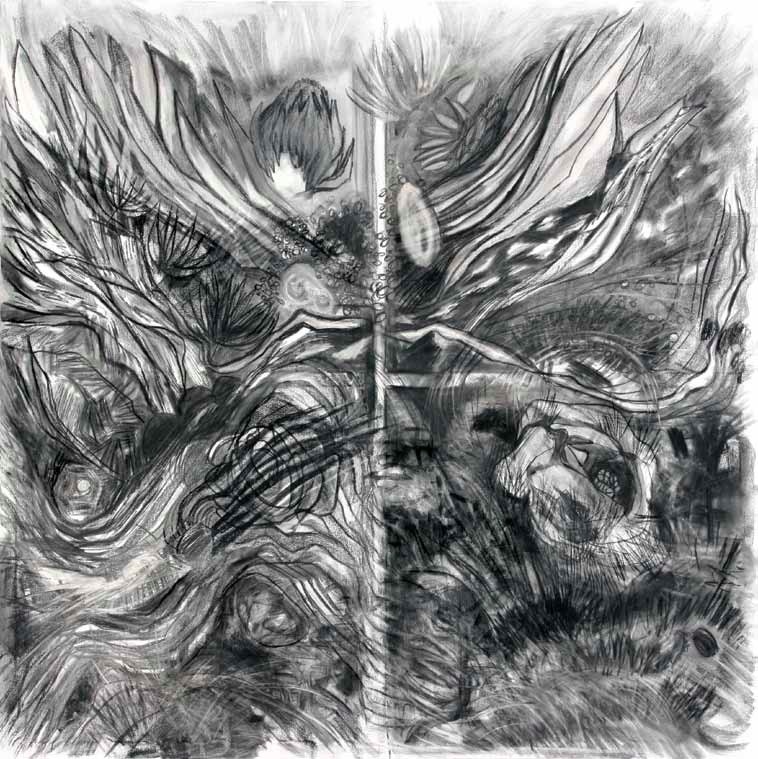
Committed to change, and having dispensed with tested conventions and tame procedures, the works of Amitava Das hold the power to stand alone. Well aware of the potentiality of his medium, he thrives on its experiential richness, exploring renewed ways of approaching visual form and expression. He relishes in art its capacity to correspond to the artist's inner feelings. No wonder, every time one encounters Amitava's art, it appears in a state of transition escaping the firm hold of conforming to a specific style, or worse, a stereotype. Like most other contemporary artists on the globe, Amitava's is an eclectic spirit disenchanted by the traditional search for beauty and perfection. He too departs from mimesis, suspending nature and the imitation that promises an instant and effortlessly recognisable phenomenal world to the viewer. | |||
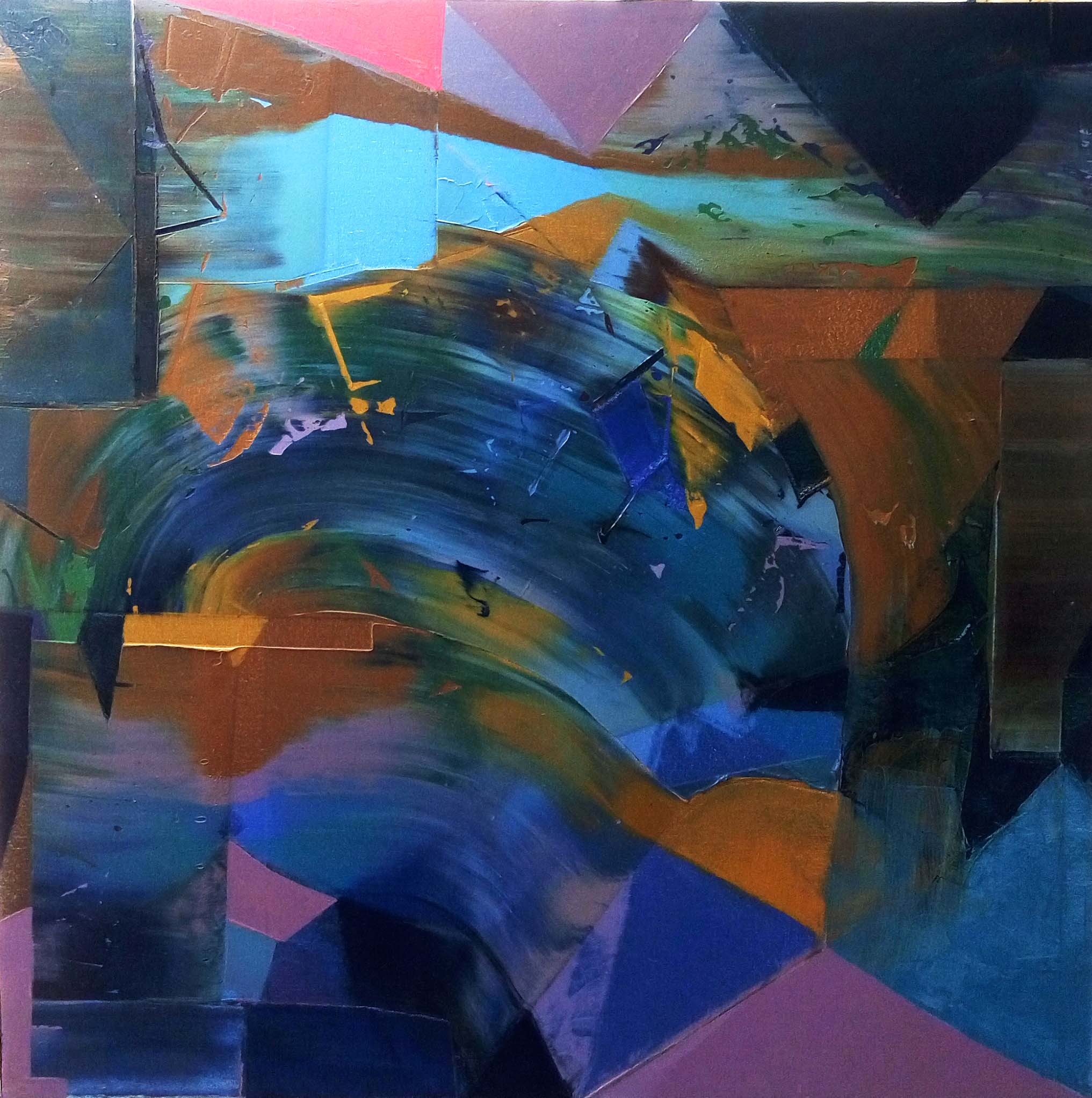
| His artistic agenda caters neither to naturalism nor to the creation of a super-natural ideal that invites veneration. Also, he seems to believe less in deliberate inflictions of moral and social obligations on his art, almost making a case for the autonomy of artistic expression. That does not make his art vacuous in character, for the person in him is a highly sensitive urban man, quiet and introspective by nature. Empty formalism is unsuited to his temperament. He is alert to what affects him, to what he responds and rejects, but in his art he hardly intellectualises. He chooses instead the path of creative liberty to honour virtues of spontaneity and pure instinct. His is a raw energy at work that refines itself through its own gestural acts, allowing each frame its organic growth and needed time to ripen. No preconceived plan or design succeeds into guiding his actions which often arise from the subconscious levels of sentience, allowing plastic signs and signals to emerge through incident accident or reverie and float in an ambience of inscrutability, vulnerable to probings. The utopian failure is witnessed in the way he discards rational structuring in his work that would demand tying up of parts into a homogeneous unity. Instead, he builds up space to become a visual field for collisions and events rather than for placing objects with precise measure. | ||||
| Of late, Amitava is increasingly involved in preparing the material base through a structural priming. He chooses a small size mount board to develop relief features on it, layering it with swabs of used fine cloth, thin broom straws, or ply sticks, crumpled rice paper, torn invitation cards, all smudged and touched wit a hand of glue, pigment as well as water. In a metaphoric sense, he prepares the burial ground to receive the image. The camouflaged markings and stuffings make a mysterious presence from the underneath of the opaquely coloured handmade paper that becomes the skin. Instead of depending on fresh and fine materials, he composes the ground of debris, obliquely expressing an environmental concern, regarding the impoverished state of resources, the need to save and recycle discards. |
The Golden Notebook, 1996 |
|||
| Sometimes, to impart the base with strength, he uses a double mount, to give it body, engineering diverse materials through the most non- aesthetic acts of sticking, tearing, crushing, patching, digging, squeezing, shaping material through prolonged physical contact. Objects of everyday use such as commercial products and their packings, for example, soap and biscuit wrappers, tissues, photocopies and photographs of his work pieces are stuck and treated over by retained tea stains, bum marks of coffee mugs, pigment blobs, ink drops, stamped ink marks from pen corks, allowing chemical reactions to occur, surface and acquire aesthetic virtues. the abrupt eruption of ideas into consciousness, his imagination travels, leaving its spontaneous foot prints on the surface as visual clues. His haptic attitude of emotionally seeing led to an inclination to poetry and music, and is traced back to a childhood spent in Shimla. As the son of a government official, Amitava lived above the railway station with his family. | ||||
The Country Sank Into
Darkness, 1996 |
Clearly impressed on his mind are the attributes of the leafy deodars and the tall pines that he observed during his walks to and from school. In the early seventies when he studied at the College of Art in Delhi, his generation of young artists were seeking a contemporary language that suited their time. The pretty demeanour of the realist forms had already been drained of their impact and become obsolete. In the absence of a formulated operational mode, the artist gets fascinated by Efforts and the credibility that rested earlier on how well the rules were followed, seemed now to rest on how well they were broken. The global connectedness also expanded their artistic vision and vocabulary, with every artist aiming to consolidate his own pictorial language. | |||
| Amitava stresses on the fact that as soon as he completed his college, he seriously engaged himself in a process of delearning to relinquish typical responses in favour of deviant inquiries. Though a man of few words, he inherited cultural readings, and was inspired by Rabindranath Tagore's poetic as well as visual expression.He identified with modem Bengali writers Sudhin Dutta and Shakti Chattbpadhay and poet Jibananda Das. Camus, Sartre, Rimbaud, Baudelaire, all rebels in their days, appetised his sensitive temperament with their quintessential views. The visual artists who made an impact on him were those who worked with innocent eyes and heard their inner voices rejecting imitation and resemblances and the authority of tradition in their art. It would not be misleading to say that Amitava's work centres around the human figure, presented in an existential predicament. The forces of decadence have overpowered evolution. The consistency of certain images seems to be pressing towards the idea of death and disintegration and even beyond to transmutation. His de-individualised human figure has no solid ground to stand upon, nor a sky above to aspire for. He stands isolated, the urban chaos and clutter insulating him further from his surroundings. | ||||
| The collapse of narrative power leads to no obviousness of content though the schematic figure is suggestive of a prognostic stance. In a characterless landscape that is stripped of all utility and beauty, he projects a sense of displacement. With the horizon lost, the force of gravity absent, there is an uncertainty revealed in terms of where to be and why to be. The existent, splintered into disjointed pieces, represents the world in its heterogeneous fragments, a world damaged beyond repair. |
Journey, 1996 |
|||
| The image of man is of one who has suffered, known pain, pathos, withering- one who has gone through it all-been oxidized, vaporized, burnt and skinned off, exposed in a skeletal armature, chained further by his own ribs and bones. He acquires an empty transparency articulated through open wiry fissures, barbed contours with swollen joineries. His robotic stances represent him as another object with mechanical responses, devoid of human flexibility and feeling. There is a complete negation of flesh, with no sensuous trappings to distract. The decomposition of the body seems to be imperative for the revelation of the spirit. The peeling off and scooping out symbolise physical torture on the one hand, and on the other, a detached method of x-raying to provide the living with an idea of their ghost-like counterpart The grotesque hardware, itself wary of collapse, is often made sterile to result in psychic disquietude. The thematic substance of his work has become residual or partial, present in symbolic fragments or traces that become a fluid intersection between the past and the present. This is expressed as one perceives more disconnections than connections, disappearances rather than appearances, evacuations rather than accumulations through intermittent signs shrouded in ambiguity and often in absurdity, his eye, able to see only shapes and shadows. Burnt Figure Still Alive has the title itself suggestive of consequenc- the figure's body space is composed of charred flesh, open bloody fibres, oxidized colour that symbolise the trauma undergone, dead but alive as ghost spirit enveloped by the colour of passive flames. | ||||
Untitled, 1993 |
The charcoal residues are affected using little torn rags,that are often his cloth to clean brushes, to look like bandaged strips that cannot sustain his bums. There are no signs of recuperation. The burnt or buried become symbolic of man's emergence from earth and his disappearance into earth also. Journey is another interesting work with the figure placed upside down, suggestive of a mind journey that rejects the use of feet. It is a journey through uncharted spaces to perhaps explore an unknown contour. Distance here is measured by time rather than a mathematical law. One sees devices of simple repetitive gestures and elemental shapes become a significant visual language. Non- analytical Sun, Moon and Figure, has an elevated patterned ground, composed of alternating shapes of the moon, crescent or full. The stitch button substitutes the graphic circle, providing a physical variation. | |||
| The completely
eclipsed environment reduces the focus on the play between two motifs. The
titles of several works are suggestive of the puns of destiny and one does
taste a blend of all sorts of flavours-from blandness to spice and sharpness
in these works. Das often uses a strong iconic form like Krishna, in a contemporary countenance as a veritable alter ego. One can see a faint snake form made to disappear, to isolate the image from the historic event to place him in a new aesthetic context. Thick jungle of soft tendril like lines swirl around to frame him in a majestic isolation. In several works, a detached pictorial eye is magnified to challenge a reversal of positions. So to say, the painted eye stares out at us in a mood to question, instead of the viewer who looks at the work expect ant of an answer. what is indeed remarkable in Amitava's art, to me, is how his simple gestural acts impart elements a visual appropriateness and a meaningful transformation. Through the process of extreme elimination, he economises visual elements just as the poet does with his words. For him, the unconsciousness in art is the sign of creation, while consciousness at best is that of manufacture. His proficiency is seen in his bold, confident lines, evocative handling of colours and, above all, his dynamic brushwork, moving in a rhythmic release of muscular energy. |
||||
| At times it resembles a spasmodic eruption, especially in his earlier works where each stroke laps up the surface with an electric current. He then primarily used the power of his brush to write his protest with needle-like piercing strokes. The surface was to bear the wound, bleed and hold fresh anguish. But Amitava oscillates between silent moods and agitating screams. His colours too shunt from muted tones of pink, grey, browns to bright, luminous blues and yellows to violent blacks and reds. He excels in the way he develops expressive textures that evoke sensations of the battered and bruised, resulting in hacked and scarred surface treatrnent. |
Untitled, 1979.09 |
|||
| Now
he seems to take great care to preserve the spirit of the material that he
amalgamates on the pictorial surface. For example in Opus, he has
the soapwrapper centrally fixed by dark thick painted stitches that seem
to visually hold it. He retains its transparency though he uses repetitive
acts of stamping on it with a pen cap. creating an inked circular motif varying
through the pressures applied to resemble musical notes. The precariously
balanced human figure and play of elements bring out a strange lyricism.
Amitava's works strive on visual contraries that are equated to paradoxical
situations held together in some productive tension. He makes space and breaks
it as well by crossing over it. The self-discovery in Amitava's work goes on with something of the thrill, pleasure and fearful experience of the childhood game of hide-and-seek, as it comes close to life's seeking of the numerous undisclosed secrets, the never ending cycles of birth and death. A close equivalent I read in the words of A.K. Ramanujan, who wrote |
||||
|
|
|
|
|